Canada (English)
 Colombia
 Caribbean and Puerto Rico
 Ecuador
 India
 Indonesia
 Ireland
 Malaysia
 Mexico
 Panama
 Peru
 Philippines
 Singapore
 South Africa
 Sri Lanka
 Thailand
 United Kingdom
 United States

How ERP Systems Close Gaps and Drive Growth
Most organizations find themselves in one of two categories. Which one best describes yours?
SCENARIO 1: Business chugs along rapidly. Prospects appear bright as customers sing their praises, and the company meets or exceeds its milestones.
SCENARIO 2: The company struggles to keep pace with customer demands and stay competitive. Overworked employees make costly mistakes. Performance drops while leaders strive to address operational inefficiencies.
Now which one demonstrates the need for a modern enterprise resource planning (ERP) solution?
The answer is both. Thriving businesses need an ERP solution to accelerate future growth and gain a competitive edge. Struggling companies need it to overcome operational, market, and customer challenges.
ERP systems transform critical business processes to increase productivity, improve customer satisfaction, and reduce costly errors. They connect disjointed processes and provide visibility into operations across the enterprise. Employees receive accurate information at their fingertips, 24 hours a day, seven days a week whether working onsite, remotely or in the field. Leaders can identify trends, track key performance indicators (KPIs), and spot opportunities with personalized performance reports and dashboards.
Cloud-based ERP solutions also pave the way for future growth by overcoming legacy technology limitations. Companies can scale their systems to meet growing needs globally without purchasing and maintaining costly, in-house hardware and software.
Let’s face it, all growing organizations eventually hit a wall. The technology and processes that once spurred success cannot support ever-changing demands. Service wanes. Errors increase. The right ERP solution resolves current issues and empowers future success.
Acumatica offers a comprehensive and connected business management suite that provides best-in-class accounting, sales, project, case, and customer management applications out of the box. Companies can streamline processes across complex manufacturing, production, distribution, and retail businesses in one easy-to-use, highly adaptable solution. The modern ERP system delivers award-winning usability and end-to-end transparency, eliminating bottlenecks that frustrate workers and diminish productivity.
This solution brief examines the seven reasons for implementing a modern ERP solution.
Reason #1
Pinpoint and Seize New Opportunities
Successful companies quickly adapt to customer needs, anticipate market changes, and pounce on new opportunities before competitors. Standalone and legacy systems do not provide the operational transparency organizations need to recognize trends or changes in customer behavior. In addition, they compromise innovation because daily tasks monopolize workers’ time and drain their creativity.
Companies need a robust ERP platform with comprehensive financial and business management capabilities to track performance and customer behavior trends so they can identify new business opportunities. Acumatica automatically transforms the raw data it aggregates across the enterprise into powerful insights, converting intelligence into real-time reports and dashboards. For example, the system can filter through data to rank products and sales regions by profitability or identify weak links in a supply chain. Companies can analyze the sales pipeline, compare available inventory to orders, track status, and evaluate customer trends. They can also study historical information to anticipate customer needs. Most ERP providers charge companies to access historical information. Acumatica does not.
In addition, companies can leverage Acumatica’s open architecture to integrate new capabilities without extensive programming. They can enter new markets with minimal IT investments and capture market share across the globe.
Acumatica empowers a growing global footprint by supporting multiple tenants and instances while securing each tenant’s data. Acumatica supports international accounting requirements, multiple currencies, and translations.
“Acumatica is enabling our growth. We are able to bring a new organization on board, show them our tools, and have them integrated with Acumatica within 30 to 60 days of closing a deal, which is phenomenal.”
Reason #2
Promote Growth with Future-Proof Technology
Many organizations invest in technology to power their growth only to discover their systems cannot scale to meet long-term needs or optimize all operations. A native cloud ERP solution fuels digital transformation as it streamlines diverse business processes across a global enterprise.
Organizations should choose a modern ERP solution that leverages emerging technologies and robust capabilities that support today’s needs and adapt to tomorrow’s demands without extensive software development. For example, Acumatica deploys web-based and open APIs to connect people, information, processes, equipment, and emerging technologies, including cloud computing, robotics, remote devices, big data, and analytics. Contract-based APIs ensure applications do not break during upgrades while the web-based architecture enables companies to extend their ERP platform without impacting the applications it supports.
The unified ERP and CRM solution drives sales growth. Acumatica enables companies to create, execute, and track marketing campaigns to generate leads. It also shortens the sales cycle by putting comprehensive customer information at their fingertips and leveraging configurable sales processes for end-to-end opportunity management. Users receive a modern ERP application that is easy to use, easy to learn, and adaptable to their specific roles.
Acumatica’s unlimited user licensing reduces IT costs, increasing working capital for growth opportunities. Engage all employees, customers, vendors, and external resources with secure access to your systems and data anytime, anywhere, on any device, with no additional license fees.
Reason #3
Gain Industry Expertise and Improve Competitiveness
Despite their sophistication, best-of-breed systems address a limited set of functions and erect walls between systems. For example, sales cannot readily identify inventory and order status when they talk to customers, which inhibits upselling and customer satisfaction. Managers cannot quickly diagnose company health, identify important deals to support, or spot performance issues. Organizations need an ERP system that connects all business processes from accounting to specialized industry workflows. Acumatica’s cutting-edge industry editions deliver a comprehensive range of specialized and general business capabilities on one centralized solution.
Construction Edition Most construction firms cannot share accurate real-time financials and project data, such as submittals and engineering drawings, between the job site and the office. This causes workers to make uninformed decisions on budgets, vendors, schedules, and project change orders. Acumatica streamlines and consolidates everyday construction processes, providing all workers with updated information on all processes. In addition, employees can optimize materials, subcontracting, compliance requirements, and worksite controls, while eliminating inventory and purchase order delays, including drop-shipping directly to the job site. Acumatica uses triggers with drill-down capabilities to expose project scopes, labor, and materials changes.
Distribution Edition Inefficient distribution processes delay shipments. Manual and disconnected packing, shipping, and inventory management processes increase costs and risks. Distributors miss new sales opportunities while striving to manage demand. Acumatica deploys warehouse automation technology, robotics, RFID, and other modern systems to optimize warehouse management and distribution processes. The ERP solution illuminates operations as it integrates disjointed systems. Warehouse, shipping, and transportation workers can manage daily tasks in one system, receive orders from multiple sales channels, and view inventory across locations on their mobile devices or PC. Distributors can also manage physical inventory and warehouse transfers, create pick lists for workers, and process packaging. They can also use Acumatica to manage omnichannel sales, returns, and exchange processing.
Manufacturing Edition Manufacturers need intuitive technology that maximizes resources while increasing engagement. Without integrated production planning, material planning, design, and execution, they cannot manage by exception, optimize inventory, and maximize resource utilization. Acumatica delivers embedded and connected functions for all parts of the business. They can eliminate wasted efforts and increase productivity by synchronizing demand with purchasing and production. Acumatica manages and analyzes production order details, costs, and resources with data collection via mobile devices for clock-in and clock-out, material issues, and real-time job costing. Manufacturers can also leverage advanced scheduling algorithms, demand forecasts, timely material purchases, and optimized stocking levels.
Retail Retail and wholesale merchants need technology that automates employee tasks and connects frontline workers with back-office operations. Otherwise, they cannot manage customer interactions, support issues, pricing, or returns because they lack a single back-end application integrated with the web store. Acumatica integrates front-end sales engines with the back-end ERP system. It supports orders from the web, mail orders, telesales, and in-store purchases and ensures that financials, inventory, product descriptions, and sales data are up to date. Companies can track order information, handle returns across channels, and offer customer-specific pricing and loyalty programs. They can deploy business analytics to respond to late inventory receipts, identify vendor quality issues, and spot online buying trends. In addition, Acumatica integrates seamlessly with eCommerce platforms and pulls in orders directly from point-of-sale (POS) devices.
“As our business is growing so quickly, it’s really important to have up-to-date information at our fingertips, at any point, any day, and at any moment. I can look at any point to see, ‘Are we meeting our forecasted projections? And do we have the right infrastructure to continue to stabilize this growth?’”
Reason #4
Improve Customer Satisfaction and Retention
The faster you grow, the harder you must work to keep customers happy. Companies that cannot consistently meet customer expectations lose business. A lack of connected, customer-centric support applications and strong customer communications lead to unhappy customers, high retention costs, and fewer referrals.
Organizations that use different systems to manage back- and front-office operations struggle to stay on top of orders. The disconnected applications prevent employees from immediately viewing the customer history and current status. In addition, employees struggle with manual tasks that lengthen response time.
An ERP solution with embedded customer management capabilities helps employees efficiently support customers. Acumatica’s unified ERP and CRM system presents users with a complete customer history at every interaction. Users can see order history, billing details, payments, communication history, and notes alongside inventory information, distribution, and production status. They can instantly identify and address issues before they cause delays.
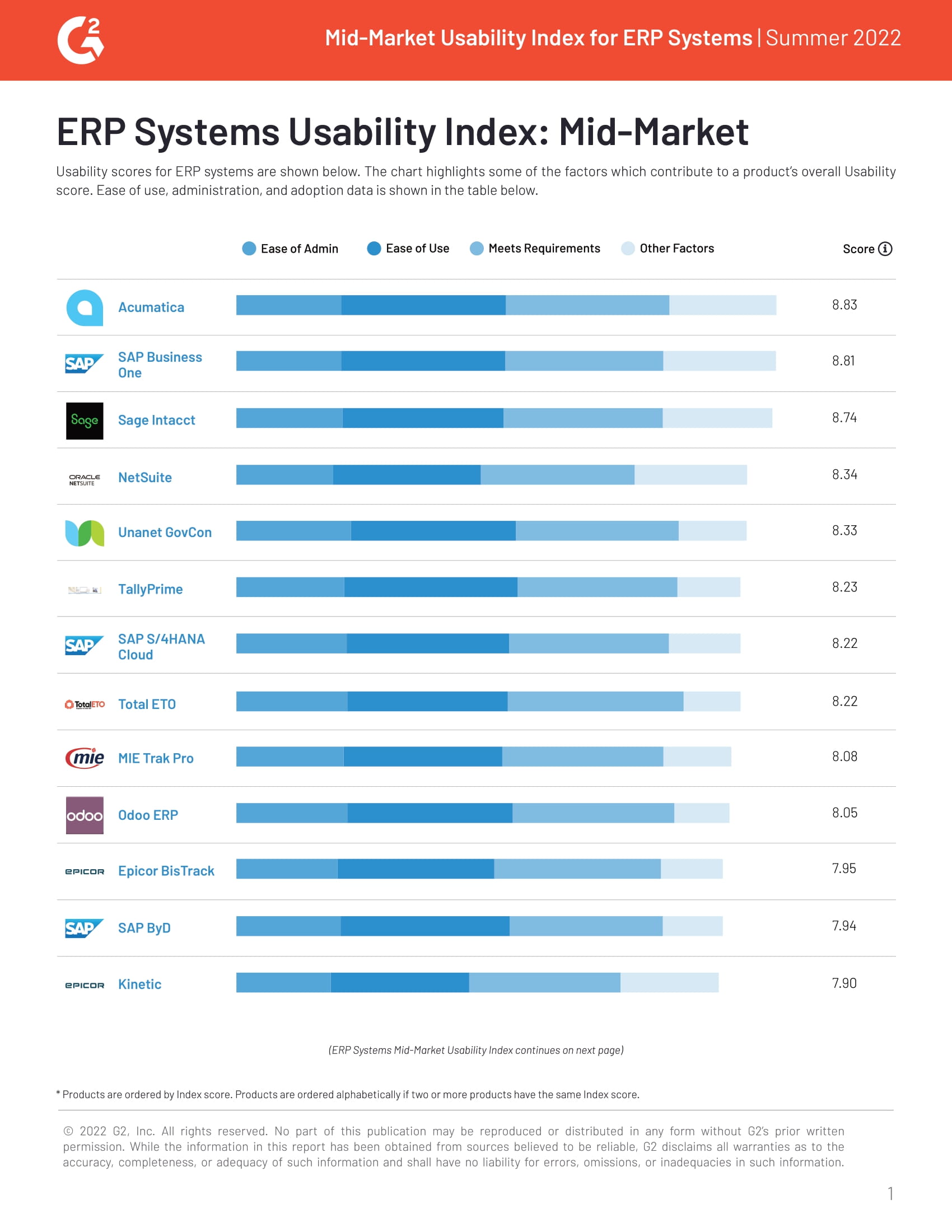
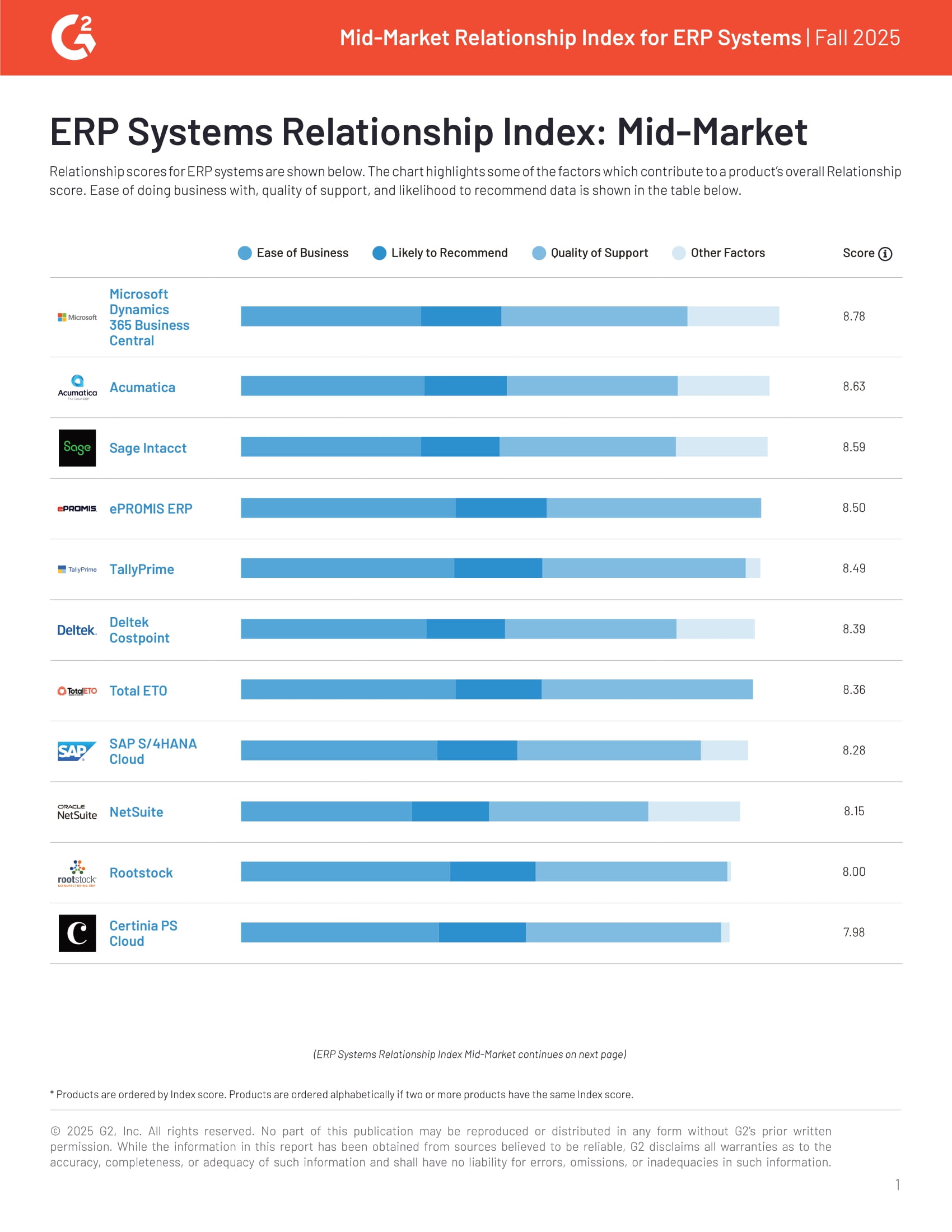
Acumatica provides a holistic suite with unparalleled breadth across an extensive accounting, sales, project, case, and customer management application suite. Acumatica is ranked #1 in customer satisfaction and usability by Gartner, Nucleus Research, and G2Crowd.
“Acumatica allows my focus to be more on the business rather than wondering where to find information. Knowledge is power and the quicker you can get to the knowledge, the better off you are. Acumatica allows me to uncover pinch points quickly. The time savings is significant. I can do a report that rolls everything up rather than wasting time manually tracking things on Excel and using a calculator.”
Reason #5
Optimize Operations and Business Processes
Most young organizations adopt new technology—one application at a time—to address specific issues, which appears cost-effective. However, the approach proves counterproductive, obstructing collaboration between teams and visibility into related operations. As a result, workers build tribal knowledge and manual workarounds to troubleshoot problems. Meanwhile, employees cannot easily find data across disconnected systems or identify the cause behind process bottlenecks.
ERP solutions eliminate productivity drains by automating manual tasks, integrating related workflows, and providing end-to-end visibility across the business. For example, Acumatica connects disparate hardware and systems across the company and aggregates real-time data into the centralized database, providing all users with instant access to one version of organizational truth. The business management software optimizes recurring processes, using artificial intelligence with machine learning to populate forms and eliminate manual data entry. Users can point and click their way to personalized dashboards and KPIs that keep them focused on priorities and their tasks moving along.
In addition, Acumatica delivers a full suite of productivity enhancers, including native applications for document management, customer relationship management (CRM), email integration, approval process workflows, time management, tasks, and appointments. Organizations can streamline accounting transactions with automation for general ledger, budgets, accounts receivable, accounts payable, and cash management activities. They can drive efficiency with automated bank feeds and AI-powered expense creation and receipt recognition. Robust native functions reduce dependency on third-party applications and increase transparency into critical functions, such as sales, marketing, and sales commission calculations, as well as fixed assets and payroll.
Acumatica’s on-the-go mobility enables employees to complete tasks, submit approvals, and collaborate with colleagues from any browser and mobile device, anywhere at any time. They can enter time, capture expense receipts, access accounts, sales opportunities, support requests, and more.
Reason #6
Évitez les erreurs coûteuses
As a company grows, so does the amount of data it generates and the tasks it must complete. Standalone applications provide little help, causing employees to juggle multiple data sources and conflicting information. Mistakes increase and often remain undetected because employees cannot view real-time workflow activity or access accurate data. Instead, they waste time searching multiple systems or making decisions based on assumptions. For example, they cannot adequately resolve a customer complaint with incomplete customer history, which jeopardizes repeat business. In addition, organizations without an ERP system rely on error-prone manual processes that cause costly delays and mistakes. Tasks like generating reports, tracking inventory, and filling orders take hours instead of minutes to complete.
An ERP solution eliminates these issues by integrating workflows, automating processes, and centralizing all data. Users receive real-time access to the latest information and historical data. Acumatica’s end-to-end transparency and robust reporting capabilities enable users to immediately identify errors and performance trends. For example, managers can see supply chain delays at-a-glance and drill down to analyze underlying causes. They have the tools to reallocate resources and address customer, employee, and partner concerns before they compound.
Acumatica presents 360-degree views of the operation so businesses can spot inefficiencies and make informed decisions.
“Once we launched, it was amazing. During the first month, we billed $1.7 million straight out of Acumatica and closed the month in 45 days. In January, it only took 30 days to close, February 15 days, and March was five days.”
Reason #7
Cessez de gaspiller votre argent dans des solutions informatiques provisoires
Companies that do not change with the times become obsolete. However, implementing new applications to take advantage of the latest innovations proves expensive and ineffective. The isolated applications cannot efficiently share information, forcing users to navigate multiple systems and adopt off-line workarounds. As a result, they make billing mistakes, fail to resolve support requests promptly, and miss lucrative sales opportunities. Companies must decide whether to plug inefficiencies one at a time or implement a comprehensive ERP suite that streamlines multiple processes and flexes to add new ones as needed.
Acumatica combines advanced financial management with project accounting, payroll, billing, inventory management, and more on a modern cloud platform. In addition, Acumatica manages connections to laser printers, barcode label printers, credit card terminals, cash registers, point-of-sale systems, eCommerce platforms, and other networked systems. Companies can easily extend the ERP solution to encompass emerging technologies to support their changing needs. The open architecture and low-code/no-code tools enable organizations to connect new hardware and software with little or no programming. They reduce costs for upgrades, backups, and database administration with a native cloud business application.
Acumatica’s future-proof ERP solution empowers companies with the ability to integrate new hardware, software, and divisions into their ERP without disrupting core operations.
Cloud-Based ERP Platform
Acumatica: The Ideal ERP Solution for Growing Organizations
Technology empowers or impedes growth. Organizations that fail to leverage modern ERP technology will lose business to competitors, who are better equipped to fulfill customer demands. For example, they will struggle to fulfill service level agreements if they continue to use different systems to manage back- and front-office operations. The disconnected processes prevent employees from viewing customer history, available inventory, and order status immediately. In addition, workers resort to manual tasks that increase errors and lengthen response times.
Acumatica delivers a scalable, secure, and cloud-based ERP solution that optimizes end-to-end processes and sets the organization up for future success. Users can access the future-proof platform on any device, anytime, and anywhere. Acumatica deploys automation and artificial intelligence infused with machine learning to streamline operations, eliminate error-prone processes, and promote innovation. Integrated workflows expedite approvals while personalized dashboards and automated alerts push critical data and activities to users. Customers can get answers to questions fast, make payments, and submit support requests anytime using Acumatica’s Customer Portal.
Organizations receive centralized access to real-time and historical data as well as 360-degree views of the customer, financial, and operational data that empower transparency. With Acumatica, organizations can access their business system and data anytime, anywhere, on any device.
Acumatica supports cost-effective growth. Companies can add unlimited users without additional fees thanks to consumption-based licensing. In addition, they minimize infrastructure costs with all-inclusive hosting, operating system, database, and administration.
The business management software empowers growth by enabling organizations to pivot and support new sales channels, markets, and geographies with multicurrency, multilanguage, and international accounting and localization. Integrate third-party systems into the platform with minimal programming with Acumatica’s Open APIs, and low-code/no-code tools. Leverage native integrations for manufacturing, construction, distribution, and retail as well as add plug-and-play, certified applications from an extensive third-party marketplace.
“Our people are more effective and can focus on relevant issues rather than manual work, and that’s as good as gold. With Acumatica’s one version of the truth, the understanding and realization that what one department does affects another has created deeper alignment and decisively improved collaboration.”