Canada (English)
 Colombia
 Caribbean and Puerto Rico
 Ecuador
 India
 Indonesia
 Ireland
 Malaysia
 Mexico
 Panama
 Peru
 Philippines
 Singapore
 South Africa
 Sri Lanka
 Thailand
 United Kingdom
 United States

Oracle NetSuite vs. Acumatica: Which Best Caters to SMBs?
According to the Office of the U.S. Trade Representative, approximately 30 million small and mid-sized businesses (SMBs) operate in the United States.1 The number balloons to 358 million when including all SMBs worldwide.2 Although these organizations are in various stages of process automation and digital maturity, they all require a technology backbone that can manage their core operations: an enterprise resource planning (ERP) system.
Two leading ERP vendors for SMBs are Oracle NetSuite and Acumatica. Beyond the basic features common to SMB ERP systems—like reporting, data analytics, financials, and customer management—NetSuite and Acumatica could not be more different where it matters most: in the implementation process, cost, usability, and support.
This Solution Brief will identify these and other significant differences between Oracle NetSuite and Acumatica and outline the critical criteria for choosing an ERP solution best suited to supporting the digital journeys of SMBs.
- Office of the United States Trade Representative. Small- and Medium-Sized Enterprises (SMEs).
- Statista. (August 2024). Estimated Number of Small and Medium Sized Enterprises (SMEs) Worldwide from 2000 to 2023.
“[With NetSuite] nothing worked fresh out of the box. It took 14 developers just to make it work. It was proprietary, so anything you wanted changed took 10 times longer than necessary to implement. Prior to Acumatica, our IT developer kept saying we should wait until the next upgrade and things would get better...but it was always a downgrade with NetSuite.”
Differentiation #1
Implementation and Risk
When an ERP vendor struggles to showcase the value of its software solution, it often turns to price as its key differentiator, promoting the lowest price to potential customers.
NetSuite regularly discounts software license fees to win new customers. They also greatly reduce the cost of implementation services to appeal to new buyers, often by 50-100%. (Yes, they offer free implementation!) It’s a common tactic for NetSuite sellers to make the deal seem too good to be true.
And it is!
NetSuite uses a prescribed implementation methodology called “SuiteSuccess,” designed to deploy the ERP software in a minimum timeframe. SuiteSuccess is the means to NetSuite’s deeply discounted implementations. To defray costs and time, SuiteSuccess follows a defined scope, meaning:
- Only core Financial Management and CRM applications are deployed.
- The solution is based on NetSuite-defined best practices, prohibits any modifications or integrations with other software, and does not provide data migration of historical data.
- Customers can be held accountable for missing planned go-live dates—with penalties from NetSuite for delaying or missing milestones.
The SuiteSuccess methodology introduces high risk into the initial implementation. With a strict scope and timeline, many customers must extend the implementation to deploy the functionalities they need to run their companies properly—or, they find the installation does not support their needs at all. Customers who engage in a NetSuite implementation should always get clarity on the project’s scope, including a detailed implementation plan with resourcing levels for each activity and deadline—in writing!
The breadth of risk associated with SuiteSuccess implementations is immense. The above scenario is not an isolated occurrence. In fact, multiple implementation partners have a dedicated business model to “rescue” failed NetSuite deployments. A simple web search of “NetSuite rescue” reveals pages of partners offering to correct incomplete and failed NetSuite deployments.
The risk is personal and professional. Yes. Directors have been fired for buying IBM. And for buying Microsoft. And for buying NetSuite.
In contrast, Acumatica partners conduct a thorough “discovery phase” at the beginning of the implementation process to ensure they meet every customer’s individualized needs and priorities. The process includes transparent, bilateral discussions with the client’s implementation team to validate the scope and project plan for success. Acumatica partners include these steps as part of the implementation cost estimate, so there are no surprise fees at go-live.
Alternatively, Acumatica offers an accelerated installation, called FastTrack Deployment, for customers that need a rapid, simplified, fixed-cost scope. But, unlike SuiteSuccess, the FastTrack methodology doesn’t bypass critical customer discovery and initial planning steps, which help verify expectations and ensure implementation goals are achieved.
And most importantly, Acumatica’s deployment methodology encourages customers to retain and leverage their unique business processes, which provide a direct competitive advantage in their markets. Rather than dictating best practices as a template for customers to follow, Acumatica adapts the software and implementation to the way customers run their operations. Acumatica flexes to business process flows today and molds to future changes. The system can be configured—without developers—to the business. The business will never have to change for the system.
Not coincidentally, a web search for “Acumatica rescue” or “Acumatica failed implementations” does not uncover failed ERP deployments but returns tips and best practices for promoting a successful ERP deployment.
Differentiation #2
Predictable Cost Structure
Catering to SMBs with limited IT staff means keeping things manageable and predictable. Cost predictability is imperative for achieving financial goals and optimizing profitability.
Acumatica gives customers predictable pricing, and intentional, customer-centric policies ensure users get the most out of their investment. For instance, Acumatica’s Customer Bill of Rights protects all customers from unreasonable and unexpected price increases for life.
Acumatica’s unlimited-user licensing model is also designed to create organizational value. Consumption-based pricing—which charges for the resources used and not for how many people use the system—allows every authorized employee, customer, vendor, and stakeholder to access the software. This price structure fosters companywide collaboration and breeds operational excellence as every stakeholder contributes to the company’s success.
For NetSuite users, licensing costs can be a big surprise. Each user requires a license, so adding part-time, seasonal, and external users increases the system’s price. Additionally, a client’s transaction volumes may incur further “resource consumption” fees that are based on Service Tiers (volume thresholds). As of April 2025, these Service Tiers are:

When their subscriptions approach renewal, NetSuite customers are often surprised to see significant price hikes that can exceed 50%—and even surpass 100%—of their original NetSuite contract costs. In addition, many are stunned to learn their contracts will renew at the deployment’s “then-current list price” rather than their initial discounted rate. Keep in mind that reducing the number of user licenses won’t necessarily lower fees.
NetSuite customers should negotiate the best discount possible during initial contract negotiations. But, please be aware the longer the contract’s term, the longer you are tied to the system, regardless of its ability to operate to your satisfaction. This, too, adds to the total cost of ownership of NetSuite. Acumatica’s contracts are always drawn up for one-year terms, so Acumatica never locks customers into long-term agreements.
“I don’t like that whenever we need something in Netsuite, it somehow is another bundle that we need to pay for. I wish Netsuite came with all the things that we needed. We didn’t know we needed a separate company to process cards, or to create automatic billing, or for dunning.”
Differentiation #3
Facilité d'utilisation
The importance of an ERP system’s ease of use cannot be overstated. Software usability directly impacts user adoption, training success, employee retention, and staff productivity.
Via its unlimited-user, consumption-based pricing model, Acumatica encourages all employees and trading partners to access and collaborate within its ERP application suite. At the same time, the system’s award-winning usability makes users want to work with the software package. The more users there are, the more streamlined and efficient the company’s processes become, all while eliminating offline, manual workarounds.
Acumatica lets end-users create and modify process workflows with an intuitive, visual engine. Users control dashboards, forms, tables, and event triggers from within their workspace. Reports and generic inquiries expose data for custom analysis, again by users. Documents can be attached to any screen; built-in wikis enable communication and reference information across the organization; and color-coded next step recommendations simplify the completion of process tasks. Integration with Adobe PDF-formatted documents allows users to annotate directly on attached .pdf files, and Microsoft Teams integration lets users contact colleagues to discuss emerging issues in real time.
High usability and flexibility make the system future-ready. It can adapt to support your changing business over time, so you can create and retain competitive differentiation as a company. Acumatica’s modern architecture allows business process experts to make changes to the system through the user interface—without developers. These configurations can be made without disrupting workflows or taking the system offline. Since 75% of Acumatica staff members work on research and development, semiannual updates pack significant enhancements into every release—many of which are based on direct feedback from the Acumatica Community.
“Whereas we were maybe shipping 3,000 orders in a day during eight hours, we’re now processing 1,000 orders an hour. That’s a lot of time and labor saved.”
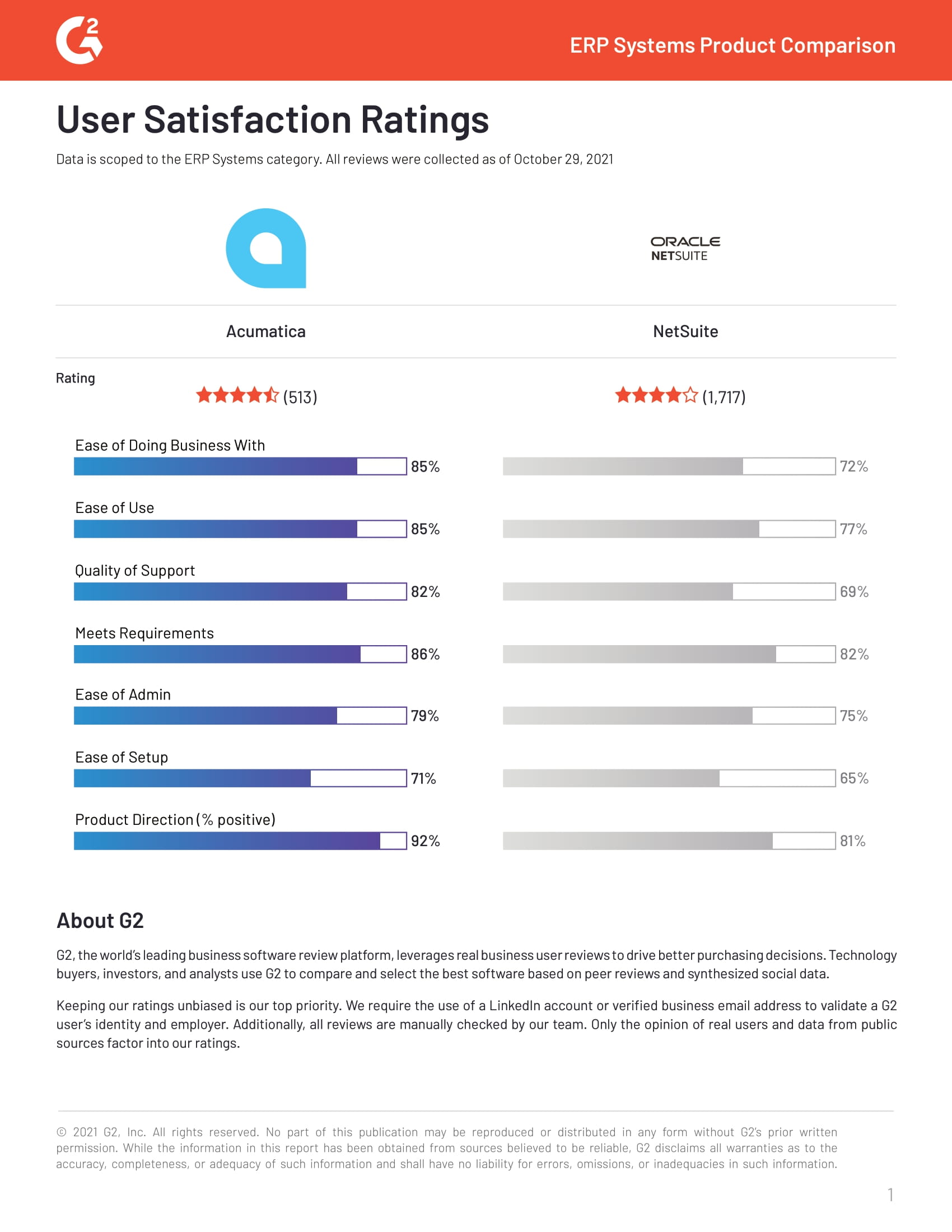
It’s no wonder that Acumatica is THE top-rated ERP suite for usability, according to G2 and Nucleus Research.
NetSuite’s usability is not quite as strong. Users complain that the system is unintuitive and hard to navigate, with complicated screens and too many ways to complete a process. It also requires a steep learning curve, and, while users find the standard reports inadequate, customizing reports is difficult, typically requiring technical expertise. Users have experienced slow performance, and suffered through multiple widespread system outages, like the “NetSuite Disaster” of February 2023 and many others (e.g., April 2025, March 2024, July 2022, Jan. 2022, Oct. 2021, July 2018).
Usability is also hampered by proprietary coding needed for customizations. NetSuite’s platform leverages “SuiteScript,” an offshoot of standard Java, which requires formal training to use. Trained resources can prove scarce and expensive for customers who lack the skillset in-house. Acumatica’s Microsoft-based .NET development environment is ubiquitous and a standard programming language. But many customizations in Acumatica require no coding at all, and those that do need coding require very little—in an industry-standard, nonproprietary language.
Some NetSuite customers lament the slow pace of NetSuite enhancements. Usability is negatively impacted when critical features are delayed from being added to the product, and users suffer for it.
Differentiation #4
L'écosystème des partenaires
A strong user community and a growing ecosystem of partners accelerate the value customers receive from their ERP solution. From consulting partners who help deploy, train, and support the application, to independent software vendors who add complementary capabilities to the core ERP suite, partners fulfill many “last-mile” requirements for the user base.
There are some noteworthy differences between the partner ecosystems of Acumatica and NetSuite.
Acumatica has a thriving ecosystem. Value-added reseller (VAR) partners continue to flock to Acumatica. Many of them have moved away from selling legacy ERP products to hasten their growth trajectory by devoting more resources to selling Acumatica’s modern ERP system. For independent software vendor (ISV) partners, Acumatica hosts a Marketplace of ISV-developed solutions—200+ total applications across 43 functional categories and growing.
Acumatica’s partner channel enjoys a symbiotic relationship with the software publisher. Acumatica relies on its VARs for ALL customer sales. There is never channel conflict between partners and Acumatica!
Customer support is similarly symbiotic. VARs serve as the first point of user support. Acumatica Customer Support remains available to address product issues as part of a dual-layered service. Strict certification requirements are mandated for all VARs, making competence a top priority for the Acumatica channel.
Acumatica takes care of the partner channel, so your VAR can properly take care of you.
How does Acumatica’s Partner Ecosystem drive success? CLICK HERE to let our customers tell you.
NetSuite sells and services their ERP product both directly and through VARs. But unlike Acumatica partners, NetSuite partners experience channel conflict on occasion with Oracle. Partners have had profitable opportunities to the tune of an alleged $56 million taken away from them so that NetSuite can sell the deals directly, pocketing the proceeds. Others claim NetSuite is difficult to work with and consider the support and training they receive inadequate to meet their channel quotas. In addition, NetSuite’s pricing model makes it very expensive for small and mid-sized businesses.
These issues impact NetSuite end-users, as disgruntled partners provide lower service levels to their customer base than “happy” partners. Further, partners who feel dissatisfied in their relationship may end the partnership and look for alternate software packages to resell, leaving current clients to find other channel options for post-sales support.
Two former NetSuite channel partners, Technology Management Concepts and The Answer Company, were disenchanted enough in their business dealings with NetSuite that they publicly wrote about voluntarily terminating their relationships. Read what Technology Management Concepts had to say about the problems with NetSuite that led them to walk away from the partnership.
“When [Oracle partner] Plexada complained to Oracle, the database titan allegedly retaliated, conducting a whisper campaign against the firm to deprive it of future deals and taking money from its Oracle Partner account to cover the outstanding amount owed by the Lagos government.”
Differentiation #5
Ease of Doing Business
How a software vendor engages with its customers provides another source of competitive advantage for companies. True partnerships between publishers and end-users keep costs predictable, deliver new functionality prioritized by customers, and maximize use of the system by all employees.
Acumatica LIVES by its mission to be the most customer-friendly ERP provider, as evidenced by:
- A formal Customer Bill of Rights, guaranteeing every user fair and friendly treatment.
- An Acumatica customer portal to facilitate collaboration with trading partners, such as vendors, customers, and outside consultants.
- A steadfast focus on developing and supporting an ERP product with industry-specific functionality through significant R&D investment. (75% of Acumatica resources help develop and test the software.)
- Free online training for ALL system users via Acumatica Open University.
- Award-winning usability, satisfaction, performance, and ecosystem ratings from industry sources G2, IDC, Nucleus Research, Gartner, SourceForge, and TrustRadius. Acumatica also won the coveted CODiE award for Best ERP Solution in 2021 and Best Construction Management Platform in 2024.

In contrast, Oracle has a questionable reputation in the enterprise software market, with many customers reporting their working relationship is strained. Some have claimed NetSuite may engage in deceptive sales practices, such as over-promising and under-delivering, underestimating price quotes, and lacking transparency.
Other users cite low levels of customer engagement, sympathy, and support. They claim NetSuite has not addressed outstanding service tickets, has shown apathy towards customer downtime, and has refused to engage in sales cycles with smaller prospects.
Oracle is further known for auditing customers and forcing sales to boost profits. In 2022, Oracle was engaged in a lawsuit in which the City of Sunrise Firefighters’ Pension Fund claimed the software giant “falsely inflated its cloud revenue…[and] misled its investors about the sales of its cloud products by threatening customers with expensive software licensing audits unless they agreed to use Oracle’s cloud software. The suit also alleges that Oracle offered customers large discounts for on-premises products if they accepted short-term cloud contracts they didn’t want and were unlikely to use.”
Another lawsuit, filed in 2023 by NetSuite customer River Supply Inc (RSI), claimed that Oracle had conducted a “‘widespread fradulent scheme and unfair business practice’” by selling NetSuite software but “failing to ‘provide all the functionality at the price promised.’” RSI further alleged that Oracle breached its agreement by “‘failing to implement a workable ERP solution and failing to perform the services in a professional manner consistent with industry standards.’”
Independent analysts, like Third Stage Consulting, recommend vetting the relationship aspect of Oracle when selecting an ERP vendor, stating “there are companies out there that don’t like working with Oracle, they find their pricing and contract structures too complicated and cumbersome, and difficult to work with.” So, carefully evaluate the critical qualities of your IT partners to secure the kind of relationship you will benefit from as a valued customer.
Acumatica is THE Choice for Small and Mid-sized Businesses
SMBs seeking an ERP platform to support their business operations have many options, including Acumatica and Oracle NetSuite. When choosing between these two, several critical criteria must be considered.
To make sure your business is able to get the most out of its ERP investment, in both the short- and long-term, look at each vendor’s:
- Implementation Methodology
NetSuite’s SuiteSuccess methodology has an extremely limited scope and introduces great risk. Acumatica offers flexible options, all of which include transparent, bilateral discussions to make sure the implementation fits the customer’s operations. - Cost Structure
NetSuite charges per-user and surprises customers with big price hikes. Acumatica’s cost structure is predictable and allows for unlimited users. - Usability
Where NetSuite users complain that the system is unintuitive, Acumatica’s usability is consistently rated #1 in the industry. - Partner Ecosystem
While NetSuite partners have sued Oracle for breach of contract, partners are flocking to—and staying with—Acumatica. - Ease of Doing Business
NetSuite customers have sued the company for unfair business practices, but Acumatica lives by its mission to be the most customer-friendly ERP provider in the industry. Read our Customer Bill of Rights to learn more.
The best choice for your next ERP system will be found from the vendor that will forge and maintain a true technology partnership with you, where your business, operations, perspectives, and success will be valued and prioritized.
“We had difficulty with the lack of timeliness of getting data into and out of NetSuite, which would mean we couldn’t be operating in real time. NetSuite also lacked the level of customization that Acumatica provides, so we would have had fewer options in the future to customize it to suit the specific needs of our business.”