 Canada (English)
 Colombia
 Caribbean and Puerto Rico
 Ecuador
 India
India
 Indonesia
 Ireland
 Malaysia
 Mexico
 Panama
 Peru
Peru
 Philippines
 Singapore
 South Africa
 Sri Lanka
 Thailand
 United Kingdom
 United States


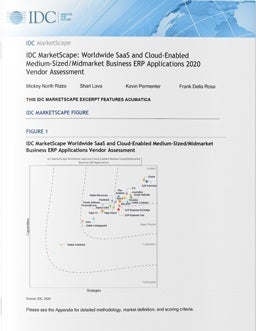
IDC MarketScape
IDC MarketScape: Worldwide SaaS and Cloud-Enabled Small Business ERP Applications 2024 Vendor Assessment
This IDC MarketScape excerpt features Acumatica
IDC MarketScape Figure

Please see the Appendix for detailed methodology, market definition, and scoring criteria.
In This Excerpt
The content for this excerpt was taken directly from IDC MarketScape: Worldwide SaaS and Cloud- Enabled Small Business ERP Applications 2024 Vendor Assessment (Doc # US50655023). All or parts of the following sections are included in this excerpt: IDC Opinion, IDC MarketScape Vendor Inclusion Criteria, Essential Guidance, Vendor Summary Profile, Appendix and Learn More. Also included is Figure 1.
IDC Opinion
Small businesses are navigating a chaotic environment on both the business landscape and the IT sides. As 2023 drew to a close, small businesses were far from drawing the curtain on economic instability and questions surrounding new advancements in AI and automation. Small businesses today are facing the challenge of running growing entities with slim staffs while also battling inflation, interest rate hikes, and labor shortages — in addition to getting their heads around how, exactly, they can capitalize on the roller coaster that is GenAI technology.
But rapid change can also be good. Swift and dramatic changes in automation capabilities have the potential to transform the often-manual working processes of small businesses that have lean staffs and less capital, enabling them to automate time-intensive, paper-based processes and therefore boost efficiency and reduce human error. Automation also enables employees at small businesses to focus on more captivating and strategic work, which can increase employee happiness and retention. Employee retention is crucial at small businesses as they lack the bandwidth of their enterprise counterparts for recruiting, onboarding, and training.
Savvy small businesses see technologies such as robust ERP systems, complete with automation and AI capabilities, as tools to not only weather growing pains and economic storms but help them come out more resilient once those storms pass. In fact, 78% of small businesses — those with 1–99 employees — plan to increase their technology spending in the next 12 months according to IDCs February 2023 Small and Medium Business Survey — that's a higher percentage than medium-sized businesses (100–999 employees) where 60% planned to increase tech spending. Smart small businesses are taking a measured, methodical approach to solving today's challenges using technology.
And many are starting with a robust ERP system that can meet their needs as they grow. In fact, 50% of small businesses listed financial management and business operations tools such as ERP solutions as a top technology priority for their company in the next 12 months, according to IDC's February 2023 Small and Medium Business Survey. These businesses are seeking to move away from entrenched, error-prone manual processes such as operating in excel spreadsheets. They are turning to ERP systems to boost speed and efficiency, gain actionable insights and, perhaps most importantly, unlock access to a single source of data truth.
Current Considerations in Small Enterprise ERP Systems
As small businesses embrace what digital advancements, including ERP systems, can do for them, they should consider the following:
- Employee and management buy-in is key: While small businesses benefit in that they are more agile with fewer massive legacy systems and red tape to deal with, many small businesses are older. In fact, over half, 51%, have been in business 10 years or longer, according to IDC's February 2023 Small and Medium Business Survey,. Many small businesses have an ample amount of nontechnically-savvy employees. While nearly 40% of small businesses list moving key data such as spreadsheets and/or document repositories into an ERP system as a top technology priority in the next 12 months (see IDC's February 2023 Small and Medium Business Survey), changing set ways isn't easy. Learning new or seemingly advanced technologies that will dramatically change an employee's day-to-day work may be overwhelming and intimidating. Adopting new methods of business requires top leadership buy-in and staff education on why and how these business process changes will pay off over time.
- It's better to conform your business processes to the vendor's system: In general, ERP systems perform better without significant customizations. Customization typically requires a small business to pay for outside help from a developer or coder, which can create a snowball effect that can add up over time as one change can create complexities that can impact other areas of a system. In addition, too much customization can make a system prone to more bugs and more fragile and complicated over time. When implementing a new technology, take the time to change your business process when needed to better fit with the system. This will pay off in the long term with fewer strains on your limited IT resources to find workarounds. It will also enable a small business to more easily take advantage of new features and functionality from the vendor's system — which is exactly what a small business needs from its vendor as it doesn't have the resources to build these internally.
- Set aside ample time for training: Start training key employees on the system before the implementation process even begins. A month-long crash course isn't the way to go — especially for a small business with a lean staff. One small business ERP customer likened implementing a new ERP system to having spinal survey while still having to walk. Employees will likely be using a combo of old systems or processes while learning a completely new ERP system, so be cognizant of this and allow ample time for employees, especially power users, to get up to speed. Backfill by hiring temporary employees or contractors at your small business to handle essential tasks, such as payroll, so that permanent employees focus on learning the next system. On that note, remember when selecting a new system that employee's processes are critical; when evaluating a new ERP system, remember that the more the employees' user experience (UX) conforms to their daily workflow, the better the user experience.
- Focus on modular systems: Modules are the building blocks of configurable applications and are composed for maximum functionality and accelerated time to value. A product with modular design is decoupled and componentized, meaning it is broken down into smaller composable independent components with singular tasks. Composable modular applications are an attractive alternative to custom-developed software products due to their minimal dependence on full-stack development talent, which many small businesses do not have. With composable applications, the SaaS vendor selling the product typically handles the maintenance and upgrades to the apps. Modular applications provide a component library and offer the ability to create new components in the application, which typically implies the API is part of the architecture composition. Modules are independent and self-contained and allow the assembly of an app with prebuilt, legacy, and/or custom modules. With modularity, a complex product, such as a physical car or sophisticated piece of software, can be divided into simpler components that are independently created and integrated (or assembled) to create the desired end product. Modular systems also enable small businesses to start with the basics and easily add on functionality (modules) as they grow.
- Be an AI and automation skeptic: Time to insight is critical in the digital world. Automation should be utilized everywhere, coupled with the data to make the right decisions and analytics to make data easier to comprehend. In addition, predictive capabilities can benefit an organization overall. However, small businesses should work to separate AI buzz from reality. The last thing a small business has time for is to beta test a new automation or AI capability by finding and reporting bugs in a glitchy system. AI and automation should be baked into the vendor's offering and ready to go. Ask for demos of such advanced technology as well as references of clients that have used a vendor's touted AI or automation capabilities and ensure your nontechnically-savvy staff can use and understand the capabilities as well.
- Be clear on help: As a small business, you likely don't have ample in-house technical resources to quickly address issues and deal with implementation, integration, or maintenance issues. What are the precise SLAs for customer service at the ERP vendors you are evaluating? Is it worth it to pay more for faster or more robust service? And make sure you use an implementation partner not only recommended by your ERP vendor but one that has completed several implementations with businesses of the same size and in the same industry as yours.
- Think (very) long term: Small businesses grow and change rapidly. Therefore, small businesses should not buy systems that simply meet their needs this year or even next. Instead, they should try and envision where their business will be (and where they want to be) three, five, or even more years down the line and seek ERP systems that will work with that future iteration of their business. On that note, it is critical to examine how often the ERP technology vendor updates its product. If infrequently, what does that mean to the pace of innovation your organization needs to take on to move successfully in the digital world? This is a crucial area to understand in both the short term and the long term.
Current Trends in Small Enterprise ERP Systems
Current small ERP system trends include:
- Flexible licensing: Small businesses are growing quickly and have smaller budgets than enterprises. A fee structure that works for them now may not be as effective by just a year down the line if their employee count, revenue, sales, and more change dramatically. Many small businesses are attracted to ERP systems that offer various levels of licenses from light up to advanced or power users, with several levels in between. Some ERP systems will work with small businesses on fee structures that fit their needs as their businesses change — as they tend to change much more quickly than enterprise organizations.
- AI/Automation: When IDC asked small and medium-sized business (SMB) technology decision-makers earlier this year which forward-looking technology areas will be priorities for SMBs in the next 12 months, ChatGPT was gaining press (and worldwide usage) and it showed in the results. Process automation, which can be fueled by AI programs by removing human tasks to save money, increase speed and reduce error, ranked as the number 1 forward-looking technology priority across all SMBs (global and the United States), as well as both small and medium-sized businesses. In addition, 28% of all SMBs are already using AI within their technology departments to manage technology. The pace of innovation is increasing, and small businesses are realizing this. ERP vendors focused on AI, ML, NLP, chatbots, RPA, and GenAI are critical partners to consider for the digital future.
- A multifaceted ERP: Many small businesses that are implementing ERP systems are doing so for the first time and are in the beginning of their DX journey. That means they may also need other technologies such as CRM, HCM, and mobile capabilities. Small businesses are receptive to vendors that offer many capabilities in one package as it can help them avoid integration headaches from point solutions that they don't have the IT manpower to handle. It can also save them time researching other point solution providers and dealing with multiple contracts and bills. Bundled offerings also typically provide cost savings. To that point, small businesses also want systems that can grow with them as they grow and that can offer additional or more robust capabilities as their needs change so that they do not need to rip and replace a system a few years down the line.
- Industry expertise: As small businesses don't have the internal time, money, or resources for heavy customizations, many veer toward ERPs that specialize in their specific industry — particularly if their industry is complex or highly regulated such as government contractors, healthcare, or discreet manufacturing.
IDC MarketScape Vendor Inclusion Criteria
- Vendors will be included based on them meeting IDC's functionality requirements for enterprise resource planning.
- The vendor must have a modern cloud offering, such as SaaS or similar.
- Vendor inclusion will also be based on market presence, small organization customers (with at least 30–50% of their revenue from small business organization of 10–99 employees) based on the information vendors provide us with, and our market share and forecast efforts in assessing the enterprise resource planning applications market.
Advice for Technology Buyers
The ERP market is shifting quickly to technology that enables an organization to compete and succeed in the digital world. These areas are focal points of consideration as your organization moves forward.
- Look internally and think about your current processes. Ask yourselves these questions:
- What are some issues we must resolve with a new system? Are they technology related?
- What are the current internal resources and capabilities? How might this change in the future with our investment plans?
- How do we define a successful implementation?
- What internal stakeholders should we include in the process?
- How will the new system change my organization?
- Are there industry aspects we could tie in better from the front end to the fulfillment of our products and services?
- Select the right partners. The first step to implementing an ERP system is to develop the right strategy and plan for implementation. Second, select the right services partners if you need them to assist you and tie your choice to the technology partner's ecosystem. Also ask yourself these questions:
- Does the vendor have the type of product, service, and company size we need?
- Can the vendor show me a hands-on experience demo with my organization's live and real data to show the benefits to the business?
- Does the vendor understand the regulations that will impact my business? How are these regulations reflected in my current product, and how will they change in the future?
- What is the vendor's strategic investment outlook for the next three to five years? Why and how will it enhance my business?
- Will the services partner help me continue our journey with the technology partner we selected? What other partners might we need on our journey?
- Consider the foundation. There are many varieties of software architectural approaches. Ask your software vendors these questions:
- What is the data flow design in the current solution?
- What kind of APIs are available from this vendor? RESTful? SOAP? GraphQL?
- What kind of developer tools does this vendor provide (e.g., sandbox, dedicated portal, low-code/no-code tools, database management tools)?
- Own the implementation. The best results require an active role in implementation. The digital world brings greater reliance on technology than ever before, so getting it right the first time is a requirement. Ask yourselves these questions to help you in your decisions:
- What levels of support are available, and are they geographically available for my business?
- How should we set up the service-level agreement before signing any of the contracts?
- Can the system integrate with my company's other IT systems and partners?
- Which IT system needs to be integrated and to what degree?
- How are you set up to deal with frequent updates? And how do we consume them faster and let the business learn as it goes?
- Note that change management is critical. Ask yourselves these questions as you get into the project so you can run efficiently and smoothly and move into the digital world quickly:
- Do we have the right strategy to encourage rapid adoption with employees?
- Do we have the right amount of training for employees to master the new features within the system?
- Are we communicating the purpose and benefits of the system change to the relevant employees?
- Have we aligned existing policies and procedures to enable the adoption of new workflows?
This IDC MarketScape assists in answering the aforementioned questions along with many others that may arise.
Vendor Summary Profiles
This section briefly explains IDC's key observations resulting in a vendor's position in the IDC MarketScape. While every vendor is evaluated against each of the criteria outlined in the Appendix, the description here provides a summary of each vendor's strengths and challenges.
Acumatica
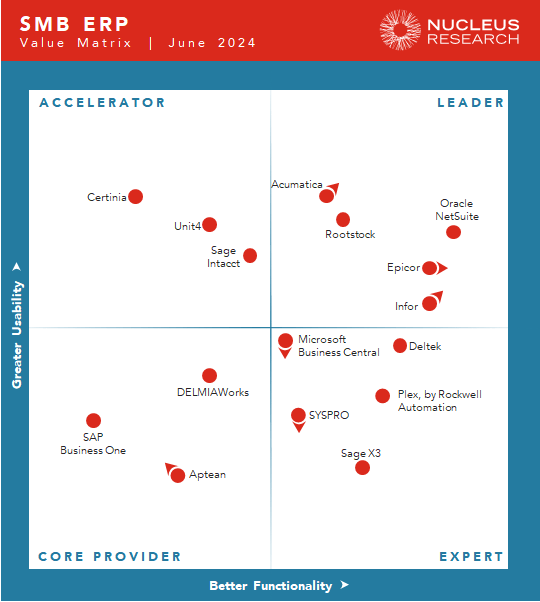
After a thorough evaluation of Acumatica's strategies and capabilities, IDC has positioned the company in the Leaders category within this 2024 IDC MarketScape for worldwide SaaS and cloud-enabled small business ERP applications. Acumatica Cloud ERP is designed for small and medium-sized businesses. Its workflows span the full suite of business management applications, and the system is built with open APIs for ease in the integration with other software. Acumatica's consumption-based licensing model is unique in that it charges for resources used, not per user. Acumatica's flexible deployment options enable customers to operate Acumatica as a SaaS instance hosted on Amazon Web Services (AWS), as a private instance hosted on the customer's own cloud, or as a hybrid of both options. Acumatica's target verticals include construction, distribution, manufacturing, and retail. In the past few years, Acumatica has grown from 100 employees to 600+ worldwide.
Quick facts about Acumatica include:
- Employees: 600+
- Total number of clients: 10,000+
- Industry focus: Construction, distribution, manufacturing, and retail
- Ideal customer size: 10–500 employees
- Average implementation time: 3–6 months
- SaaS and cloud: Customers can operate Acumatica as a SaaS instance hosted on Amazon Web Services, as a private instance hosted on the customer's own cloud, or as a hybrid of both options.
- Partner ecosystem: 577
Points forts
- Hosting flexibility: Acumatica offers hosting flexibility that many rapidly growing small businesses need as they evolve and grow. It offers cloud ERP with on-premises capabilities so customers can host on their own private cloud, or clients can use AWS to host or use a hybrid of the two.
- Fee structure: Acumatica charges by consumption or resources used, not per user or by seats or licenses. This is attractive for small businesses that are budget conscious and do not want to pay the price of a full license for a light user who may only use the ERP system occasionally, such as for payroll.
- Partner network: Acumatica also boasts a strong partner network of nearly 600 partners. Small businesses without large in-house IT resources often need a network of strong, knowledgeable, and reliable partners to help with integrations, customizations, and implementation.
Défis
- Support: Customers note that they are directed to go through their VAR for support, which means support is only as good as the local VAR. Therefore, the small business must thoroughly vet and maintain a strong relationship with its local VAR.
- More inclusive road map: Customers note that many updates are focused on specific verticals. They believe Acumatica could focus more on bolstering the basics such as interfaces and modules. In addition, references believe a solid focus on CRM would be very beneficial so the clients don't look to an outside solution such as Salesforce.
- Growing pains/brand perception: While Acumatica is growing rapidly — it has grown from 100 to 600+ employees in a matter of a few years — many references say it is still not a widely known system among their industry peers. One reference noted that while Acumatica is growing rapidly, its profile hasn't risen at the same rate. More marketing by Acumatica will help assist in brand recognition.
Consider Acumatica When
Small businesses in the construction, distribution, manufacturing, and retail sectors that are evolving rapidly and want an ERP system with flexible hosting models and a strong partner ecosystem and fee structure that doesn't charge per seat but by usage/resource used/volume of activity should consider Acumatica.
Appendix
Reading an IDC MarketScape Graph
For the purposes of this analysis, IDC divided potential key measures for success into two primary categories: capabilities and strategies.
Positioning on the y-axis reflects the vendor's current capabilities and menu of services and how well aligned the vendor is to customer needs. The capabilities category focuses on the capabilities of the company and product today, here and now. Under this category, IDC analysts will look at how well a vendor is building/delivering capabilities that enable it to execute its chosen strategy in the market.
Positioning on the x-axis, or strategies axis, indicates how well the vendor's future strategy aligns with what customers will require in three to five years. The strategies category focuses on high-level decisions and underlying assumptions about offerings, customer segments, and business and go-to-market plans for the next three to five years.
The size of the individual vendor markers in the IDC MarketScape represents the market share of each individual vendor within the specific market segment being assessed.
IDC MarketScape Methodology
IDC MarketScape criteria selection, weightings, and vendor scores represent well-researched IDC judgment about the market and specific vendors. IDC analysts tailor the range of standard characteristics by which vendors are measured through structured discussions, surveys, and interviews with market leaders, participants, and end users. Market weightings are based on user interviews, buyer surveys, and the input of IDC experts in each market. IDC analysts base individual vendor scores, and ultimately vendor positions on the IDC MarketScape, on detailed surveys and interviews with the vendors, publicly available information, and end-user experiences in an effort to provide an accurate and consistent assessment of each vendor's characteristics, behavior, and capability.
Market Definition
ERP is a packaged integrated suite of technology business applications with common data and process models that digitally support the administrative, financial, and operational business processes across different industries. These processes manage resources including some or all of the following: people, finances, capital, materials, suppliers, manufacturing, supply chains, customers, products, projects, contracts, orders, and facilities.
ERP suites and the associated applications are utilized to run the business and typically start with finance and include procurement and inventory/asset management and may also include HCM, order management, manufacturing, distribution, services, engineering, PLM, and supply chain. The software can be specific to an industry or designed to be more broadly applied to a group of industries.
Typically, ERP solutions are architected with an integrated set of business rules and metadata, accessing a common data set (logical or physical) from a single, consistent user interface. ERP
En savoir plus
Related Research
- Market Analysis Perspective: Worldwide Enterprise Resource Planning Software, 2023 (IDC #US48563322, December 2023)
- Worldwide Enterprise Resource Planning Applications Market Shares, 2022: Cloud Is It! (IDC #US47984221, December 2023)
- Worldwide Enterprise Resource Planning Applications Software Forecast, 2023–2027: Digital World Brings Changes (IDC #US48563722, December 2023)
- Macroeconomic Turbulence and the SMB: What Today's Tech Vendors Need to Know (IDC #US51366423, November 2023)
- IDC FutureScape: Worldwide Intelligent ERP 2024 Predictions (IDC #US51300923, October 2023)
- IDC FutureScape: Worldwide Small and Medium-Sized Business 2024 Predictions (IDC #US51281523, October 2023)
- 2023 Worldwide SMB Market Profile Update (IDC #US50572423, April 2023)
Synopsis
This IDC study provides a thorough assessment of market-leading SaaS and cloud-enabled small business ERP applications and discusses the criteria that are most important for companies to consider when selecting a solution.
"Organizations of all sizes embracing the digital world are focused on speed, scale, agility, market share, and competitive advantage. This requires adapting new ERP technologies that enable speed and scale by reducing process steps and clicks, automating every workflow possible, embedding finance to collect and make payments, and helping improve overall decision velocity," said Mickey North Rizza, group VP, IDC's Enterprise Software. "The ability to improve the employees' experience, uncover and utilize insights quickly, and navigate business issues with reliable, modern, and intelligent ERP systems is a foundational layer the organization needs in the digital world."
"Savvy small businesses see technologies such as robust ERP systems, AI and automation, and more as tools to not only weather growing pains and economic storms but to help them come out more resilient once those storms pass," said Katie Evans, research director, IDC's Worldwide Small and Medium Business Research. "But it's imperative that small businesses find the right ERP fit for their industry, size, unique business challenges and strengths, staff makeup, budget, and goals."
About IDC
International Data Corporation (IDC) is the premier global provider of market intelligence, advisory services, and events for the information technology, telecommunications, and consumer technology markets. With more than 1,300 analysts worldwide, IDC offers global, regional, and local expertise on technology, IT benchmarking and sourcing, and industry opportunities and trends in over 110 countries. IDC's analysis and insight helps IT professionals, business executives, and the investment community to make fact-based technology decisions and to achieve their key business objectives. Founded in 1964, IDC is a wholly owned subsidiary of International Data Group (IDG, Inc.).
Global Headquarters
140 Kendrick Street
Building B
Needham, MA 02494
ÉTATS-UNIS
508.872.8200
Twitter: @IDC
Copyright and Trademark Notice
This IDC research document was published as part of an IDC continuous intelligence service, providing written research, analyst interactions, and web conference and conference event proceedings. Visit www.idc.com to learn more about IDC subscription and consulting services. To view a list of IDC offices worldwide, visit www.idc.com/about/worldwideoffices. Please contact IDC report sales at +1.508.988.7988 or www.idc.com/?modal=contact_repsales for information on applying the price of this document toward the purchase of an IDC service or for information on additional copies or web rights.
Copyright 2024 IDC. Reproduction is forbidden unless authorized. All rights reserved.