
 Canada (English)
 Colombia
 Caribbean and Puerto Rico
 Ecuador
 India
India
 Indonesia
 Ireland
 Malaysia
 Mexico
 Panama
 Peru
Peru
 Philippines
 Singapore
 South Africa
 Sri Lanka
 Thailand
 United Kingdom
 United States
 AcumatiCares


Qu'est-ce que la gestion des stocks dans le secteur du bâtiment ?
La gestion des stocks dans le secteur de la construction consiste à suivre, contrôler et optimiser les matériaux, les outils, les équipements et les fournitures dans les entrepôts, sur les chantiers, dans les véhicules de service et au sein des projets. Elle aide les entrepreneurs à éviter les ruptures de stock, à réduire le gaspillage, à améliorer la trésorerie et à respecter les délais des projets.
Les stocks ne se résument pas à de simples matériaux ; ils constituent le moteur qui assure la réussite des projets de construction. Une gestion inadéquate entraîne des retards, un gaspillage de ressources et des occasions manquées. Cet article examine comment une gestion plus intelligente des stocks aide les entreprises de construction à gagner en visibilité, à améliorer leur trésorerie et à assurer le bon déroulement de leurs projets.
Pourquoi la gestion des stocks est-elle importante dans le secteur de la construction ?
La gestion des stocks est essentielle, car les matériaux de construction sont souvent transférés entre différents chantiers, entrepôts et équipes de terrain. Sans visibilité en temps réel, les entrepreneurs s'exposent à des retards, à des achats en double, à des excédents de stock, à des vols et à des calculs de coûts de chantier inexacts.
Une gestion efficace des stocks de chantier garantit que les matériaux arrivent au bon endroit et au bon moment, ce qui permet d'éviter les dépassements de budget.
Lorsqu'on gère mal les stocks, les liquidités restent immobilisées dans des matériaux inutilisés, les délais des projets prennent du retard et le fonds de roulement diminue. Dans un secteur hautement concurrentiel, une gestion efficace des matériaux n'est pas seulement une question opérationnelle ; c'est une question stratégique.


L'équation « stocks-flux de trésorerie »
L'équation « stocks/trésorerie » met en balance les pénuries de matériaux et les excédents coûteux afin d'optimiser votre fonds de roulement.
Considérez les stocks comme un indicateur finement réglé qui permet d'équilibrer deux extrêmes. D'un côté : les ruptures de stock, qui ralentissent les équipes et obligent à passer des commandes urgentes et coûteuses. De l'autre : les excédents, qui mobilisent des ressources et immobilisent le fonds de roulement.
Trouver le juste équilibre constitue un défi permanent pour les responsables du secteur de la construction et de l'ingénierie, où :
- La complexité augmente à chaque nouveau chantier, sous-traitant ou exigence spécifique du projet.
- Les excédents de stock et les ruptures de stock sont tous deux coûteux, que ce soit en raison des frais de stockage, des vols ou des retards de facturation.
L'objectif est clair : aligner autant que possible les niveaux de stock sur les besoins réels des projets, afin que ceux-ci se déroulent sans heurts et que les entreprises conservent leur agilité.
Cycle de vie de l'inventaire du projet
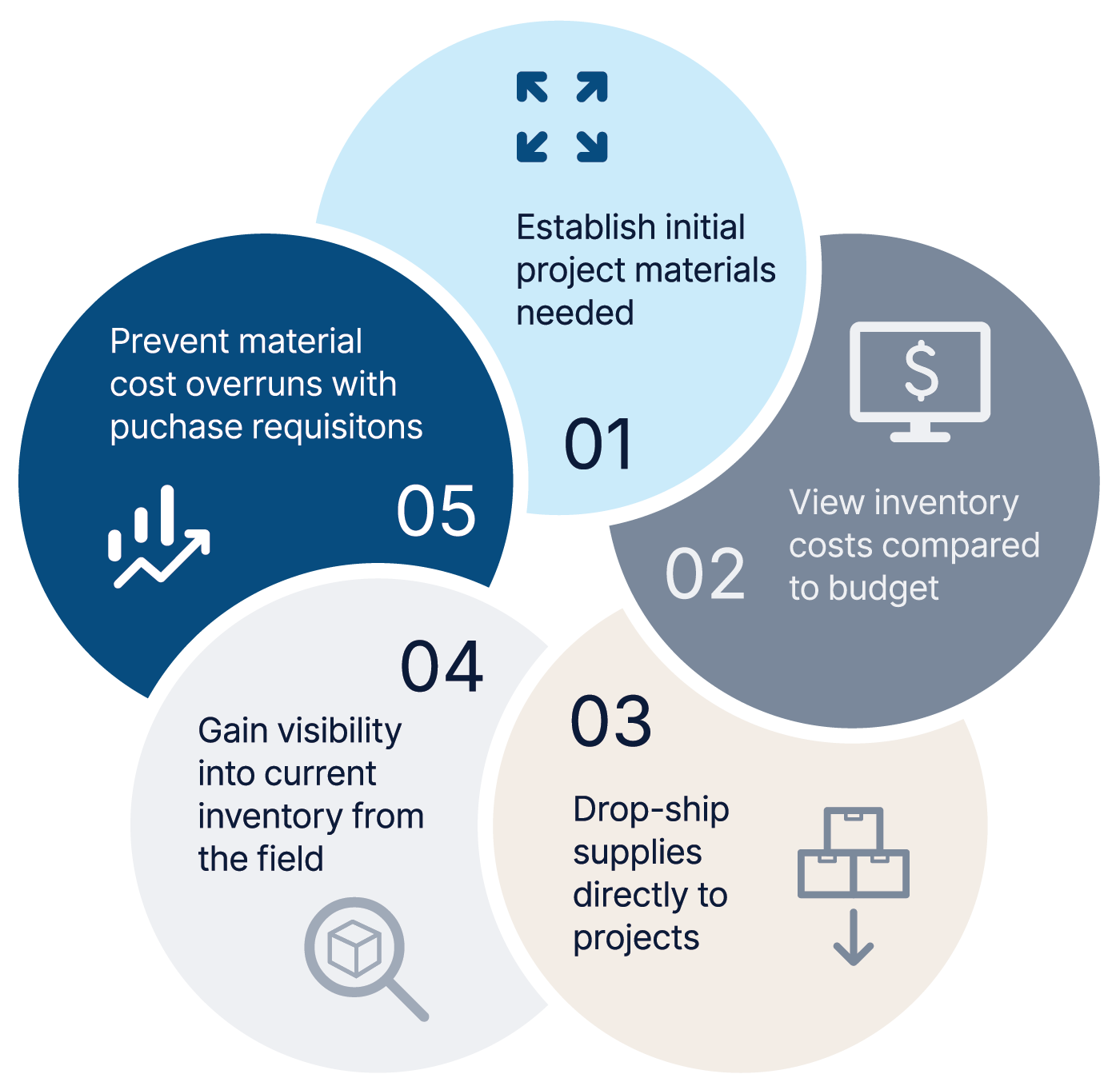
Cette infographie présente un processus en cinq étapes : identification des besoins en matériel, comparaison des coûts par rapport au budget, livraison directe des fournitures, suivi des stocks sur le terrain et prévention des dépassements de coûts. Sa forme circulaire met en évidence le caractère itératif d'une gestion efficace des stocks.
« Ayant travaillé avec Acumatica, je peux affirmer que cette solution a joué un rôle essentiel pour notre entreprise. La plateforme est spécialement conçue pour les petites et moyennes entreprises comme la nôtre, ce qui facilite grandement la gestion des stocks. Les analyses détaillées sur la production et les nomenclatures sont impressionnantes et nous permettent de nous concentrer davantage sur nos activités principales. C'est une communauté solidaire qui favorise l'innovation et la croissance. »
Pourquoi les outils de base ne suffisent pas
De nombreuses équipes de chantier commencent par utiliser des tableurs, des systèmes comptables basiques ou des applications de gestion des stocks autonomes. Ces outils peuvent s’avérer efficaces lorsque les stocks se limitent à un seul entrepôt ou à un petit nombre de chantiers en cours. Mais à mesure que les projets, les sites, les camions de service, les équipes, les sous-traitants et les besoins en matériaux se multiplient, ces outils disparates compliquent la tâche lorsqu’il s’agit de savoir ce qui est disponible, où cela se trouve et quel est l’impact sur les coûts des chantiers.
La question n'est pas simplement de savoir si les équipes sont capables de recenser les stocks. Il s'agit plutôt de déterminer si elles peuvent relier les décisions relatives aux stocks à l'approvisionnement, aux calendriers de projet, aux opérations sur le terrain, à la facturation et aux résultats financiers.
| Approche | Idéal pour | Points forts | Limites |
|---|---|---|---|
|
Tableurs |
Des équipes très réduites, des listes de matériel simples, un suivi ponctuel | Peu coûteux, flexible, familier à la plupart des équipes | Mises à jour manuelles, problèmes liés au contrôle de version, pistes d'audit limitées, absence de visibilité en temps réel, difficulté à établir un lien avec le calcul des coûts des travaux, les achats ou les activités sur le terrain |
|
Logiciel autonome de gestion des stocks de chantier |
Les équipes qui ont besoin d'un meilleur suivi des stocks mais ne sont pas encore prêtes à relier la gestion des stocks aux services financiers et opérationnels | Meilleur suivi des articles, fonctionnalités de lecture de codes-barres ou d'utilisation mobile, visibilité au niveau de l'emplacement, alertes de réapprovisionnement | Il se peut qu'il n'y ait toujours pas d'interconnexion avec les systèmes de comptabilité, de gestion de projet, d'approvisionnement, de facturation et de reporting |
|
ERP en nuage avec gestion des stocks |
Des entreprises de construction en pleine expansion qui gèrent plusieurs chantiers, des entrepôts, des véhicules de service, des fournisseurs et des flux financiers | Réunit en un seul système la gestion des stocks, les achats, le calcul des coûts par projet, la comptabilité de projet, les équipes sur le terrain, le reporting et la gestion financière | Cela nécessite une mise en œuvre plus stratégique, une harmonisation des processus et l'adhésion des utilisateurs dans tous les services |
Les tableurs sont souvent le premier outil utilisé, car ils sont familiers et faciles à personnaliser. Cependant, ils reposent sur une saisie manuelle des données, ce qui signifie que les registres d'inventaire peuvent rapidement devenir obsolètes.
Un tableur peut indiquer que des matériaux sont disponibles, alors que l'équipe sur le terrain sait qu'ils ont déjà été utilisés, déplacés, endommagés ou rendus.
Un logiciel de gestion des stocks autonome améliore le suivi, en particulier pour les équipes qui ont besoin de recenser les articles, de connaître leur emplacement, de scanner des codes-barres ou de recevoir des alertes de réapprovisionnement.
Toutefois, si les données relatives aux stocks ne sont pas intégrées à la comptabilité, aux achats, à la gestion de projet et au calcul des coûts par projet, les équipes risquent de ne pas avoir une vision complète de l'impact des matériaux sur les marges des projets et la trésorerie.
Un système ERP dans le cloud intègre la gestion des stocks dans le flux de travail global du secteur de la construction. Au lieu de traiter les matériaux comme une tâche opérationnelle distincte, l'ERP relie la gestion des stocks aux bons de commande, aux budgets de projet, aux coûts des chantiers, à l'activité des entrepôts, aux équipes de service et aux rapports financiers. Cela permet aux chefs de projet, aux équipes d'approvisionnement, au personnel des entrepôts et aux responsables financiers de disposer d'une source d'information unique et fiable.

Pourles entreprises de construction qui gèrent plusieurs sites, la différence est considérable. Un progiciel de gestion intégré (ERP) aide les équipes à répondre plus rapidement à des questions concrètes :
- Quels sont les documents disponibles actuellement ?
- Quel site d'emploi a un excédent de stock ?
- Quel projet est bloqué en raison d'un retard de livraison ?
- Est-ce qu'on achète des articles qu'on possède déjà ?
- Dans quelle mesure les coûts des matériaux influent-ils sur la rentabilité des projets ?
- Quels articles en stock faut-il transférer, renvoyer ou commander à nouveau ?
À mesure que les entreprises se développent, la gestion des stocks ne consiste plus seulement à compter les matériaux, mais surtout à coordonner les décisions à tous les niveaux de l'entreprise. C'est là que les outils isolés montrent leurs limites, et que les systèmes intégrés apportent une valeur ajoutée tangible.
« Acumatica m'a permis de gérer efficacement la rotation de mes stocks entre les chantiers de couverture et m'évite d'avoir à suivre les coûts via des transactions distinctes. Je peux gérer mes activités de construction un peu comme s'il s'agissait d'un modèle hybride de distribution, et Acumatica s'adapte toujours à mes besoins. »
Ce que permet une stratégie moderne de gestion des stocks
Une stratégie moderne de gestion des stocks permet une visibilité sur l'ensemble des sites, une planification proactive et un calcul précis des coûts par projet, afin de respecter vos budgets.
Une gestion rigoureuse des stocks permet de transformer le chaos en maîtrise et de faire des défis liés à la chaîne d'approvisionnement une source d'avantage concurrentiel.
Parmi les principales stratégies, on peut citer :
Les entreprises suivent leurs stocks sur tous les chantiers, dans tous les ateliers d'ingénierie, entrepôts et camions de service, ce qui leur permet de réaffecter les excédents et d'éviter les commandes en double.
En s'appuyant sur des données historiques et en temps réel, les équipes prévoient les besoins pour chaque phase du projet ou chaque étape clé de l'ingénierie, ce qui réduit le recours aux estimations approximatives ou aux commandes de dernière minute.
Les équipes peuvent fabriquer et gérer des composants préfabriqués, tout en assurant le suivi des matières premières.
Les équipes coordonnent les achats avec le calendrier des projets, garantissant ainsi que les matériaux n'arrivent qu'au moment où ils sont nécessaires et réduisant le risque de vol, de perte ou de détérioration.
Les matériaux sont suivis de leur réception jusqu'à leur installation, ce qui permet aux responsables financiers et aux chefs de projet de vérifier l'exactitude des factures et de respecter rigoureusement les budgets.
Les excédents sont identifiés et réaffectés ou restitués à mesure que les projets s'achèvent, favorisant ainsi la durabilité
FAQ sur la gestion des stocks dans le secteur du bâtiment
Quels sont les principaux défis liés à la gestion des stocks dans le secteur du bâtiment ?
Parmi les défis courants, on peut citer le suivi des matériaux sur plusieurs chantiers, la gestion des excédents de stock, la prévention des ruptures de stock, la coordination des transferts entre sites, la réduction de la saisie manuelle des données, la prévision des besoins en matériaux, ainsi que l'intégration des données de stock avec les achats, la comptabilité de projet et les opérations sur le terrain.
Les tableurs suffisent-ils pour la gestion des stocks dans le secteur du bâtiment ?
Les tableurs peuvent suffire aux très petites équipes ayant des besoins simples en matière de gestion des stocks, mais ils perdent souvent de leur fiabilité à mesure que les entreprises de construction se développent. Les mises à jour manuelles, les problèmes de gestion des versions, les retards dans la production des rapports et le manque de cohérence des données rendent les tableurs peu adaptés à la visibilité en temps réel des stocks, au calcul des coûts des chantiers, aux achats et au suivi des matériaux sur plusieurs sites.
En quoi un progiciel de gestion intégré (ERP) améliore-t-il la gestion des stocks dans le secteur de la construction ?
Un progiciel de gestion intégré (ERP) optimise la gestion des stocks dans le secteur de la construction en mettant en place un système centralisé pour la gestion des stocks, les achats, le calcul des coûts par projet, la comptabilité et le reporting. Cela permet aux équipes de visualiser les matériaux disponibles, de transférer les excédents de stock, de réduire les achats en double, de suivre les coûts par projet, d'améliorer les prévisions et de prendre de meilleures décisions grâce à des données en temps réel.
Quelles sont les meilleures pratiques en matière de gestion des stocks dans le secteur du bâtiment ?
Parmi les bonnes pratiques, on peut citer le suivi des stocks par site, l'imputation des matériaux aux coûts des chantiers, la définition de seuils de réapprovisionnement, l'utilisation de flux de travail mobiles ou basés sur les codes-barres, la prévision des besoins en matériaux par phase de projet, le transfert des matériaux excédentaires d'un site à l'autre, la vérification régulière des stocks et l'utilisation de logiciels intégrés pour relier les équipes de terrain, d'entrepôt, d'approvisionnement et des finances.
Comment les entreprises du bâtiment peuvent-elles réduire leurs stocks excédentaires ?
Les entreprises de construction peuvent réduire leurs stocks excédentaires en améliorant la planification de la demande, en assurant le suivi des matériaux sur les chantiers, en transférant les articles excédentaires avant d'acheter de nouveaux matériaux, en alignant les achats sur les calendriers des projets, en retournant les matériaux inutilisés lorsque cela est possible et en utilisant des rapports en temps réel pour identifier les stocks à rotation lente ou les doublons.


